You can contact us though the following email address: porthudsonorganics@gmail.com

Monday, June 18, 2007

Making Peppermint Tea

well...making tea-bags.
The Coreopsis had taken over the peppermint beds, And I didn't have the heart to pull them out, so I let them do their thing. Several years ago, we planted a row of Coreopsis in the garden, and it got six feet tall, and we even tied it up with an elaborate rope system to keep them all from falling over. It was beautiful. It will also never be necessary again. Because, since that experiment, coreopsis sproings up all over the garden every year. And in the yard, and anywhere else it can.
This year, a bunch of them popped up in the mint beds. They're just so beautiful. It's impossible to mow them down or pull them up before they've bloomed and set seed. Well, they did all that, and it was time to rip them out and cut back the mint, which had grown long, long trailing vines in it's efforts to reach past the coreopsis plants. I mean, how much mint could that possible be? Turns out, way, way too much to handle at one time. I sat in the carport all day long; with the hose running and a scissors and the big mesh garden cart - cutting and washing and trimming and bagging and on and on and on. But I got it done. Then begins the drying process, whereupon I mentally thank for the billionth time my friend Maria who gave me the professional herb dryer on 'permanent loan'. With it's flat leaves, mint dries faster than many other herbs (like rosemary, for instance). But it still takes more than a day. You have to catch it between 'limp but mostly dry' - and 'so dry there's no aromatic essence left'. Then, one rack at a time (and I process about ten at a time), you must remove all of the stems, even the teeny tiny ones. That's kind of a pain, but there' no way around it. This is why dried thyme should cost a million dollars an ounce. What you wind up with is a big bowl of crushed, dried, fabulous peppermint, and boy do your hands smell great, and plus your entire respiratory system is thankful. You've been inhaling mint for hours. Now comes the confessional part.
Long ago, when I first ordered teabags, I would stuff them with whatever herb I was making tea from, then sit and stare and the unsealed side of the teabag. I even sat with a friend or two and asked for advice. How do you think you're supposed to close up this side? So I would fold the edges and staple it shut. I even had those little white tags on a string. It was ok, but never looked that good (certainly not professional), and you could never really get it completely closed no matter how hard you tried. This means little scraps of tea would leak out when you put it in a cup of hot water. It was much later that, in desperation, I went looking for an answer on the internet. well. lo and behold, you're supposed to iron them shut! who knew? not me. Let me tell you. This is a great trick. Actually, it's not a trick. It's the way it's supposed to be done. So there you have it.


A little bit of 'packaging ingenuity', and you have teabags to sell in the market tent. Also, a jar of teabags for your own self. yes. It Is A Lot Of Trouble, all told. But, everybody spends their time doing Something. And I can think of a lot of other things I would rather not be doing. It's worth every step.

Monday, June 11, 2007

the 'Any Minute Now ' Edition

We have had a lovely 5-day visit from Will's mother, and although we mowed and did some picking and selling and a tiny bit of planting (and Will did beekeeping and tied tomatoes), we have not really been in the garden very much. So, last evening my mother-in-law and I wandered around the garden to take pictures...all I can say is; everything happens so fast in a garden. The Borage - a foot high a week ago, is now knee-high and quite stunning: But the real surprise are the ANY MINUTE NOW vegetables: Corn, tomatoes, and melons...and then there are the BEES! We did want bees, and by god we have them now. They are everywhere. Not just in the garden, of course. They do so love the lemon balm flowers. I need to cut them back, but I was in the garden early on Saturday. Early, but not early enough. I will have to sneak out at 6 a.m. (they do sleep in just a little). Or wait until 8 at night, when they go home. I'm not just fighting them in the squash row anymore.

In the meantime, I have learned that if you want to hose down the patio, you'd better do it in a hurry, because once the bees find out you're spraying water all over the place, they run over there. They do love (and need) water.

Two weeks and one day

from: First Sunflower of the Season to this:

Tuesday, June 05, 2007


No time lately for new pictures or tirades or cute postings; we have been working hard, as we always do in the early days of June. Hose-dragging, vegetable-picking, mowing time is here with a vengeance. Last week I was amused at my early attempts to beat the heat. This week, it is not a joke. You know, all year long I look forward to green beans. What a fantasy! Green beans are a wonderful thing, no doubt. But after a week or so of trying to keep them picked, you are thinking how wonderful it would be to just plow them under (!) That may sound evil, and I'm sure all of you would love to have some fresh organic green beans. But as I write this, there is a 75 ft. row out there that would take a single person most of one day to pick. I kid you not.

The yellow beans have been equally prolific this year. I actually sent out an 'emergency!' to our email list on Sunday due to yellow bean excess. By the end of the day, much of the row had been picked by hearty individuals who showed up and thought it was not so bad out there at noon (!) well, more power to them. The effort is worth it to most folks. The beans are indeed very wonderful. But enough of bean talk.
This morning, I was tasked with picking the yellow squash first...and that seems an innocent piece of work. We don't even have a whole row. We were trying to be conservative...and smart. I mean, how much squash can one garden really have before it's a joke? I waded in there with a knife. It's not so bad if you wear gloves. Smarter if you have long sleeves, which I didn't. But I moved slowly, because the new bees think the squash belongs to them, not to me. And they are fighting over each and every squash blossom. If you take your time, they can't figure out what the heck is annoying them (and it's you).If you look closely, you can see that there are three or more bees in this flower. I'll show them, though. I;m going out in the morning to pick these precious flowers. We'll make stuffed (and fried) squash blossoms for dinner.

Sunday, May 27, 2007

This day in the garden


It has been a long, long day around here. Early in the morning, I was out in the garden...I keep thinking I have to get out there because by 8:00 a.m., it will be too hot to work. But we really aren't there yet. It is still May, and the mornings are cool, and there is a breeze. But I guess I have heat paranoia. The goal is the mulching of the herb beds. There are 18 of them. They are in rows...3 across - 6 deep. We have a method now. Will dumps bales of hay in the evening and I come out in the morning and do the mulching. Cut the ropes. Drag the twine out from the bale. Roll up the twine and walk over to the benches. Must not leave twine in the garden (0r anywhere else for that matter). Think of running the mower over twine. yikes. Peel off section of hay. Walk to the end of the bed. shake, shake, stuff, stuff. Turn your head when the wind scatters the detritus. Get hay in your shoes. See the little particles stick to your legs where you have slathered the sunscreen. Walk back to the bale. Repeat. Every now and then, hear a bee or catch sight of a bird out of the corner of your eye. Stand up and listen. And look. And remember that you're moving too fast. For no reason. Pull the sweat rag out of your pocket and wipe your forehead. Dab the sweat and sunscreen out of your eye. Step back and admire your work.
When I'm finished with the bales that are scattered here and there, I like to sit on one of the benches and just take stock before deciding which thing needs to be done next. Watch the purple martins for a few minutes. Feel grateful.

Will wants to finish the mowing. We've been doing tag-team mowing the past few days. I like to mow, actually. Like anything else, I like it for the first hour...then it gets tedious. And hot. But there are some places I won't go. Like the steep ditch by the road. Like the entire section by the beehives. Like really close to the pond. We almost have everything mowed. This happens about once a month. By the time you're through, and everything looks so park-like, you're too tired to enjoy it, and wish you had company so they could see it too, but you're too tired for that. You don't even have enough in you to carry on a conversation. So he drives the mower to the front to mow out by the road, on the outside of the fence, and he carries a plastic bag because, as we know, people throw things out of cars. Hey. It's Louisiana, after all. Most times, it's just paper. Sometimes it's beer bottles. Sometimes it's stuff like clothes. Nobody knows why. After this, he starts the dreaded weed-eating. The more stuff we plant, the more things there are that need weed-eating. When we first bought this property, there wasn't a bush or a tree or any living thing on this property, save a single oak, one magnolia that looked rather sickly, two crepe myrtles up against the house, and two little matching bushes in the side yard that we couldn't identify, although the movers called them 'sweat-bee trees'. Six acres. six things. period. My mother tried to cheer me up by saying 'But you have a blank slate! you can do anything you want!" And all I could think was...'there's nothing here. Nobody has ever planted anything on this property. Where to start? I wish there were trees!' Well, we sure fixed THAT problem. It took Will HOURS to finish the weed-eating. Trees, bushes, flowerbeds, fencelines...Literally hundreds of things to attend to. But that's ok. Maybe ten years from now, we won't be able to do all of this. But for now, we can. Hey, ten years from now, the billion trees we've planted will shade out their own weeds, right? And Will will say - 'I 'm not going to plant the whole garden this year. ' But he says that every year. ha.
Will was still working....fertilizing the melons and it was almost dark. So I fed the cats and the dogs and the fish. After my morning rounds in the garden, I kept to the shade. Re-potting plants, labeling the jelly, hanging out the laundry and that kind of thing.
So it's rediculously late, and I have someone coming early in the morning for beans. I am not at all sure whether they wanted to come early to pick beans, or whether they expect me to pick them before they get here. I guess I'll get out extra early and pick at least some. Hedge my bets. And there are more hay bales waiting for me. I don't mind hauling them myself, but I am deathly afraid of the red wasps, so after my first couple of mornings of facing that evil, Will has stepped in to save me from spending 15 minutes carefully prying one bale from the stack and, with much fear, hauling it into the cart behind the mower. I'm trying to enjoy the garden in it's pristine state. It will not be more beautiful this year than it is right now.

Saturday, May 26, 2007

About those beans...


I thought, a handful of yellow beans, how nice.
Well, things are never that simple.

The Garden This Morning...in pictures

This morning's sweet surprise
green beans, yellow wax beans


coreopsis...the gift that keeps on giving


feverfew


first sunflower of the season


little sweet potato plant

lemon basil


zinnias in the garden

Wednesday, May 16, 2007

Honey Harvesting...a first attempt


not so many words - the pictures tell the story. In the previous post, you will see the bee hives, and the 'boxes' on top of each. This is our late (late) evening honey getting experience. And quite a mess it was, I must say (!) This is the result of one box from one hive. I have a feeling there will be quite a bit of honey in our near future...and I certainly hope we can figure out some other place to do this...Like - maybe outside...The scary-looking knife is HOT. (It is electric and smokes like the devil. I am in charge of the extension cords. Plug it in...when it smells like burned honey, unplug! Wait. Plug it in. etc. etc.) The goal is to uncap the little cells the bees have made...stick the racks in the big aluminum thing and spin!


A very sticky business, all in all. I have to hand it to Will, though. When he decides to get something done (like, bees...like, honey) he gets it done completely, and in very short order! In the end, my thought is this: I have never really seen this much honey in one container in one place - ever.

Sunday, May 13, 2007

Bzzzzzzzzzzzzzzz

bees...finally...Not a hard decision - we'd been thinking about this for a while anyway. But the distinct and mildly frightening lack of bees on this property all spring sealed the deal. Where to get a hive? I found the Louisiana Beekeepers on the 'net. Emailed the current president. He got right back to me. Actually, what he really wanted was for Will to show up at the Tuesday meeting. I kept pushing him for a contact instead - which he did give. But Will thought - no - best to go to the meeting. That was smart. Lots of bee folks, actually; and very nice folks indeed. He came away with cards and phone numbers and whatnot. And a direct line to a guy across the river who had ten or so hives he was trying to sell. So - the following Saturday evening Will goes across the river to Morganza and buys two hives (full of bees, naturally), and a big metallic thing that spins out the honey (looks like a giant ice-cream maker). He calls from the other side of the river at St. Francisville. (the Mississippi river). This means he is waiting for the ferry. Now, I don't know about you, but if I was getting onto a ferry and a guy drives his pickup truck onto the ferry with two beehives full of bees in the back of the truck, I would not be well for that. It was dark, and it was Saturday night, and no one seemed to notice. ha.
Well, everything went without a hitch. A friend was here to help offload the hives. Of course, Will had made extreme preparations, because that's just the way he is. He laid concrete footings, and set up cinder blocks and painted them white, and faced the whole shenanegins towards the rising sun to warm the bees in the morning. Within the first week, the Prez of the Beekeepers showed up out here to help Will 'go through' the hives for the first time. That was incredible. Also, Will's beesuit arrived. He puts it on...'does this look funny?' Well, that's a matter of opinion, I guess. It looks like coveralls with a hazmat hood, I suppose. It looks like 'first man on the moon'. It looks safe, for sure. It's kind of cool, actually. It took almost a week, but the other morning, I picked the first yellow squash of the season, and there was a bee in every single flower (!) whew. After weeks (months, actually) of walking and scanning all things flowering for any sign of bees at all, and finding a pitiful one or two here and there, it was a glorious sight. Lagniappe; ('something extra') The hive with the extra box on top...well, that box is full of honey, waiting to be taken. There are boxes to build and paint (came in the mail, sitting by the bookcases in the front room). And this will be done soon. So that there will be more honey this year. I know so little about all of this. Will is excited about the honey. I am excited about bees on flowering plants. Something for everyone.

Wednesday, May 02, 2007

a very quick note about a very beautiful thing

My daughter told me these would never, ever grow here. Ox-Eyed Daisies. She said they are wild and rampant in the Northwest...but it's just too hot here. And last year, when I started some from seed and put them in the herb beds, they nearly all died. She was right, I thought. Its just too hot. But one clump did hang in there, and here we are, a year later. There is also a clump of them way over in between two other rows. This means they seed themselves pretty freely. Lesson: if you can nurse something through the first year, you have a fighting chance. Lesson 2: Ox-Eyed. Daisies, obviously a predecessor of the Shasta Daisy, makes THING TWO in the herb beds that works because it is the hardy older variety. Thing One was the Bergamot, predecessor of the hybrid Bee Balm. (see last year). We've had Bee Balm: temperamental, and hard to pull through to next year. But Bergamot - well, it's all over the place now.

Tuesday, May 01, 2007

Time for a new FISH IN THE HAND picture - but not tonight.


It's been a month or more...but finals at school are at hand, and putting in the garden is an every-spare-minute thing. So...just to get things cranking for spring blogging, a picture or two:
Spinach. Thank you. And little tiny baby salad greens...a beautiful thing, to be sure, but a little harder to be very, very creative about: toss them on a little plate, throw some mandarin orange slices and cherries and sprouts and seeds on there, and...well. The arugula (in the middle of the row): some days yes, some days not so much. It is overpowering when matched with delicate lettuce greens. And a picture of this and that (thanks to Will and his new camera...he couldn't help himself but maybe I'm possessive about mine...) First - the purple martin house. Will always DID want one. We do not know why we have only three pairs of martins in this, the second year. Will seems to think we would have a billion pairs...or at least one in every little apartment. I mean, he went through a lot of trouble making sure each little apartment was separated from the others (I did joke last year that he should just go ahead and give every apartment a little barbecue pit and maybe wind chimes). But we are grateful for the ones we do have, and as long as we keep our distance with the mower and the tiller, they don't fuss to much. And, of course, we have the 'pond and fountain' feature...I laughed at first (it seemed so absurd) but i have come to love it, especially the sound of water...

And now, about this season...young as it is: It think things are different, although I can't be sure. You always think, every year...when did I plant what? When did this or that bloom? Unless you keep meticulous records about all these things, you cannot go back to check of course: This afternoon I looked out of the kitchen window and hey! gardenias! well - that's fabulous. Seems a bit early...and then, tonight, I went onto the patio and, reaching down for the hose, I came face to face with a night-blooming cereus flower. What a surprise! Isn't it early for that? Hey,. If everything blooms now, what's left for later? And we have clover come up and bloom all over the place before we can mow again. Now, clover is a wonderful thing, but I don't remember that ever happening. You know, it comes up and you mow it down and that's about it..in the spring. But over and over again? and so quickly? what's up with that? who knows. Tonight, Will it at the monthly Louisiana Beekeepers meeting. Not that we are beekeepers, but we had a hive a long time ago. The problem is, there are no bees here. Well, one or two. Think about that. One or TWO? Bees? So it's time to get a hive. More later about that. This is pretty serious business.

In the meantime, these rows of plastic have now been planted with melons. Yes, we need bees.

Monday, March 26, 2007

..And Will checks in...a scientific explanation

It’s the oxygenation, stup... Let me rephrase. In a closed ecological system with dynamic nutrient inputs, oxygen quickly becomes a limiting factor in the overall health and balance of the system. This is especially true when what you are trying to culture is dependent on oxygen to live (and thrive). Maybe the lights were unnecessary. But if you are going through all the trouble to (hand) dig 160 feet of ditch for buried cable and assemble, wire, float and anchor an aerating fountain, might as well go for broke (literally). It wasn’t THAT expensive. However, counting the price of the pond, fish, fountain, and feed we would probably much better off buying catfish at the local seafood house. Of course, we wouldn’t know where they came from and they would not be as fresh and I couldn’t witness the joy of my spouse as she catches one after the other, which I happily take off the hook and drop into the bucket (and later into the fry basket).

I’ve learned a lot about fish farming. Maybe I take it too seriously (lights excluded), but once I have committed to raising something, I start to worry about whether I have considered all the aspects and am doing what is necessary to ensure success. I hate to fail, though I have on many occasions. But I am in particularly adverse to the stinky evidence of fish farming gone bad. I blame it partly on the fish hatchery guy. I really only wanted a reasonable amount of fish for our half-acre pond, 400 hybrid bream and 150 channel catfish. In cavalier fashion, the fish guy ensured me that 1000 fish can easily be raised in a half acre pond and, besides, fish by the thousand would be much cheaper per fish than buying less. I should have known from the outset that this guy was fast and loose. After I carefully filled clean ice chests with water adjusted to pond temperature, bringing a thermometer with me to ensure no shock to the fry from the hatchery truck tanks, the guy just sticks his hand in the ice chests and says, “That’s close enough!” So now I have 1000 dependents that I can’t declare on my taxes. No way am I going to let them down, nothing too good for them. And all was well until Spring when they started to eat more and grow more and excrete more and now I am watching the pond go through textbook water quality changes. From turbid (adjusted with lime), to clear and pretty, to cloudy again (nitrophilous bacteria converting ammonia to nitrate) to matted floating filamentous algae – yuk, to now a healthy dark green (suspended algae) thanks to the fountain, the physical raking of the filamentous algae, the dry peroxide, and the application of pond microbes (the aqua-sphere Thais referred to). I’m not imagining that I am out-of-the-water on this so to speak, but I am happy with the results and you can indeed raise 1000 fish in a half-acre pond, but it takes a much greater degree of attention than it might otherwise. For those who have farm ponds or are considering them, the best publications I have found that can be accessed on-line are from the Southern Region Aquaculture Center of the USDA Cooperative State Research, Education, and Extension Service at http://srac.tamu.edu/index.cfm?catid=25

Wednesday, March 14, 2007

a red bush and a fountain


ok. this will be brief. My mother gave us this little tiny stick of a bush when we moved here eight years ago. We put it in the side yard, under the oak tree, thinking, well, how big can it get? Apparently, pretty big. And every year I see some at a local nursery, and I vow to remember the name of this plant, and next year I can never remember what the heck it is. But it is truly beautiful. Plus, its an evergreen, and we all love that. So, here it is this week, in all it's glory. Same color as a true natural azalea, and every bit as magnificent:And, for our other evening fun, I give you the latest in Will's 'POND MANIA'.....wait for it...
the fountain with the blue lights! I tell you, I truly believe this man (who does indeed love his pond) has finally lost his mind. Sorry, Will. And of course I'm kidding. But it hits me at first as excessive. Yeah, yeah, I know. Oxygenization, which is probably misspelled. And the pond scum has been a big problem and the peroxide in a plastic tub (or as I prefer to call it, a tub of 'scum-be-gone') may not do it, as the 'BALL' of whatever, and I cannot keep up and don't remember what THAT is, may not get rid of the scum either. Thus, the argument for the ULTIMATE fix, the fountain! The survey so far says....let the man have his fun, and 'man, that is really great'. So, I will give it time. More later, but here is the daytime pic. Can't get the after-dark one...I must be doing something wrong, but I'll keep trying for that:
You've seen the pond at it's low ebb, before it filled, and you've seen the bird-kite, so this is just the next chapter in what I predict will be many, many chapters of pond excitement.

Sunday, March 04, 2007

SPRING......no stopping it now....


When you notice the tops of the oak trees start to get 'fuzzy', and the red flowering trees and tiny green leaves of the willows in the swamp between here and New Orleans, you know it's almost time. But it's when you see the deep green grass and weeds creep up to the edges of the roads, you know there's no stopping it...spring is actually here (!) I tromped around outside to see what's what and look for signs and there are many, many signs of the new season...clover, ah yes. And various other wildflowers...now don't you people from the frozen north get jealous, although I am glad we are not in the land of snow. Come August or so, remember you'll be having the famous last laugh.
In the garden, things are peeking out from way, way underneath. So we never got around to cutting back the 'sticks' from the perennial sunflowers or the tarragon or the bergamot, but now that all sorts of craziness is happening down at the roots, cutting back old growth is rewarding. Here is the bergamot, as an example...
and the peppermint, coming up from the roots as well, although this we 'weed-eated' in the late fall, to get rid of the old growth: well - enough of tiny little bunches of new leaves....I mentioned the 'I Hate The Winter Grass' springtime problem, and digging out from it in the garden. It's kind of beautiful, really, because it is a deep dark green when everything else is brown and seemingly dead...but it is a terror just the same. To make my point, here is some probably wonderful fennel - but you can hardly tell, because the winter grass has taken over completely: and, after nearly two days of hoeing and hand-weeding, here is some of the lettuce that had suffered the same fate, but when you look the lettuce in Whole Foods, and then pull your hand back, thinking "wait. we have lettuce. I'm just lazy"....and now we have lettuce. And , after trying to crank up the mower, and going out for a new battery of course, and it could be worse, so that's good...a little part of the yard is mowed, and one flower bed planted, and we work outward from there. In the meantime, the fish we put in the pond in the late fall are growing like crazy...they expect food every day at 5:00 p.m. Don't try to feed them at 4, or 3, because they simply won't eat at that time. It's getting almost scary, the way they boil to the surface. I'm trying not to think of actually eating them, although I look forward to that...but they aren't as anonymous as some other fish from some other pond. that's pretty silly, i know. This is the best I can do for now, but it gives you a tiny idea of what it looks like at feeding time.More later

About Our CSA


We are entering the sixth season of our CSA (Community Support Agriculture). What began as an experiment for the creative marketing of our produce has developed into a fulfilling experience for us and our members, one that we so look forward to each year. What you will find below is an explanation of how we operate the CSA, the cost, length of season, expected commitment, etc. We ask that you read it carefully before responding. We have dedicated members that stay on year after year, but for a number of folks, it is challenging to come out every Saturday for nine weeks running and to have time to participate. For those who love the quality of the vegetables, herbs, and flowers – and who like the experience of planting, harvesting, and interacting with others who have the same likes, it is a very rewarding experience. Please read on…

What is Community Supported Agriculture? (CSA)

Community supported agriculture is a movement that got its start in this country in the mid-1980’s, driven by a desire by neighborhood groups to re-connect with local growers and producers. The CSA movement is enjoying increasing popularity and availability with each passing year. The goal of CSA is to involve the vegetable-eating-public more intimately with “their” farm. Why do I use “their” in that description? Because in CSA, members buy a share of the farm which, in effect, provides them an ownership stake in the vegetables produced. In that respect, the farmer and consumer become partners. There are many benefits from this relationship to the farmer and consumer alike. For the farmer, it provides a guarantee of sales so he can plant to supply his contract. It also minimizes the time required to market the produce, freeing him up for what he does best, which is…farm. For the consumer, it guarantees a steady supply of farm fresh produce for a fixed price, encouraging healthy eating, and promoting a sense of participation and community around the farm that has been long lost in the age of industrial agriculture. For both the farmer and consumer, it promotes a bond based on trust and mutual interest. For those interested in information on CSA and farms that have set up these systems, the web has worlds of information available with a simple word search.

Why did Port Hudson Organics decided to become Port Hudson CSA?

For most of you who have spent any time visiting our farm and talking with us, you are aware that Thais and I both work full time, maintaining our little farm, bee hives, yard, and other farm-related activities in our “spare” time. This means that virtually every waking hour that we are not at work you would find us in the field or manning the produce tent (or carport). As we expanded our farm-related enterprises to areas such as biodiesel, berries and bee hives, the farm demands finally exceeded our available time. So in 2009, in order to continue our farm sustainability effort and reduce our time commitment (primarily the time spent selling), we tried a concept that is becoming increasingly popular across the country in the “Eat fresh, Eat local” movement, that is, the CSA farm. In the spring of 2009, we enrolled (what ended up to be) 25 CSA member families, and were blown-away by the success of the venture. Member enthusiasm, assistance, and clear appreciation for the unsurpassed quality of our produce resulted in an excellent experience for everyone involved. Since then, we have expanded our enrollment to approximately 40 member families, which is a comfortable carrying capacity of our one acre garden. At this point in our lives, with regular jobs and other commitments, we have no plans to expand further.

What kind of vegetables are grown and how are they distributed?

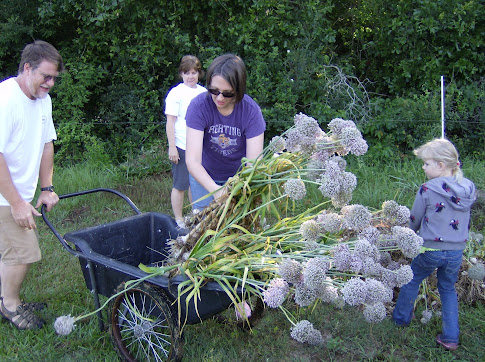
We grow a wide variety of Spring and Summer vegetables (generally about 20 different varieties). At any time during the season, you can expect around 12-15 different offerings, and 6-8 culinary herbs. We also grow cut flowers, usually zinnias and sunflowers. Each week members will receive a selection list by email. Members then make 7 selections of vegetables and 2 selections of herbs from the list. Members can check off their first and second preferences and we will make every effort to supply the members with their selected items. In cases where we are short on a particular item, say, yellow squash, we will substitute another available vegetable (for example, zucchini) from member’s second choice selection if at all possible. Members are free to make notes on their list if there is a particular vegetable they do not want (for example, zucchini) and we will try to honor their request. The amounts (pounds or numbers) of vegetables or herbs per selection were based on an approximation of equal value based on the prices we have charged for these items in the past. And as last year’s members know, the amounts of produce on the list are the minimum amount you will receive. Often, when there is a surplus beyond what has been selected, we will throw in some “lagniappe”. Members should note that there are a couple of exceptions on the selection list: a bouquet of flowers, when available, counts as two selections from the herb list; similarly, watermelon, when available, counts as two selections from the vegetable list. Each week, a basket with all of your produce and herbs will be made up with your list attached. Blank lists will be available for you to fill out for the following week, as the mix of produce and herbs change with the weather.

Can I select more than one of a particular item?

Yes, if you want 6 pounds of tomatoes one week, you can simply put the number “3” next to the selection “2 lbs. tomatoes” on your sheet and pick four other vegetable selections to make a total of seven selections. If we have enough tomatoes to satisfy your request, we will provide that amount. If we are short, we will attempt to at least provide you with one selection of tomatoes and make up the rest of your basket with other choices. We will let members know each week which vegetables we expect to have in abundance. For example, due to space considerations, we have limited plantings of corn and each planting is generally available for only one Saturday, so we will be encouraging members to select as much corn as they can from the list on the weeks that corn becomes available (we try to send out weekly emails on the state of the farm). Of course, members will also be given preference for the purchase of additional vegetables if, for example, you want to freeze a bushel of corn when it comes in and there is surplus available.

How will the CSA Baskets be distributed?

Members choose to come to the farm either Friday evening or Saturday morning each week during the season. Once you arrive, you can choose from a variety of garden activities in progress and lend a hand. This can range from planting and/or picking vegetables; washing, weighing, and bundling produce; cutting and arranging flowers; cutting and separating herbs to order; helping to pack baskets with weekly selections; sitting under a tree with other members and stripping beans off of plants. Occasionally there is a bigger project at hand, such as erecting the cucumber fence or helping to mulch rows with hay. There will be weeks when you are not able to help due to your schedule, but we find that most of our members help out almost every week. The process takes about an hour, and when you leave you bring your weekly basket with you. Many find this outdoor activity in the garden a respite from their work week in an office!

Members are asked to pick up their CSA baskets each Saturday by 10:00 AM. This is probably the biggest commitment you will make as part of the CSA. We understand that it may be difficult to come every Saturday for 9 weeks, but there are a couple of strategies you can employ to make this easier. (1) you can buddy-up with one or more members in your area and go on alternate Saturdays, each delivering or holding the other’s basket for pick up at their house; (2) you can send a family member or close friend; or (3) you can come Friday afternoon to help with the harvest and bring your basket home with you then (we had a lot of members take this option, as we do a lot of harvesting on Friday in advance of the Saturday bedlam).

What if you have a crop failure or natural disaster?

A CSA is a partnership between the farmer and the consumer, and within this partnership is an understanding of shared risk. That said, we do not expect members to bear the full cost of a catastrophic failure, nor have we ever experienced a completely failed season. Should the worst happen, members will be reimbursed a portion of their investment and we will do all in our power to make it right with members through a combination of refunds and discounts on following seasons.

What time commitment is asked as part of the CSA?

CSAs, by definition, include member support. Each week, literally hundreds of pounds of produce must be harvested, hundreds of bunches of herbs must be clipped and tied, and dozens of flower bouquets must be picked. Without member support, this is logistically impossible for part time farmers. Hence, we ask members to commit to help in some fashion (picking, sorting, filling orders, etc) according to their abilities every other weekend or so (we are not rigid on this). We have found that members enjoy becoming involved in the process. Learning about how food is grown and harvested is an uplifting and educational experience. After all, that is why we do it. And it is an integral part of CSA farms across the country. We are assuming that you found us because you appreciate this connection, and we hope that you can find the small amount of time to required to experience that connection.

What is the cost?

Cost of the CSA membership is $350. This covers 9 weeks of farm fresh vegetables, herbs, and flowers of your choice. This comes out to about $38 per week, probably more than you would pay at the grocery store for conventionally-grown produce, but less than you would pay for organic produce at Whole Foods. The quality of the produce, however, cannot be approached by any supermarket, and the experience is priceless. Also, membership in the CSA includes a pint of our farm honey when it becomes available.

In Summary

So that about covers it. If you want to experience first hand the pleasures of seeing, smelling, picking and eating truly wholesome food, please respond quickly to this email. We would appreciate some information on you and your family, and why you want to join the CSA. We will let you know within a few days, and will ask for payment at that time. We ask that you understand that we have about twice as many families on the waiting list as we have openings. However, if you do not make in into the CSA this year, we will give you first shot at joining next year if you are still interested.

Thank you so much for your interest in our little farm. We hope to see you this spring.

Will & Thais Perkins

Port Hudson Organics CSA